
The WNBA spent three decades building a valuable audience. Its newest problem is that outsiders have learned how to use it for free.
The WNBA spent three decades building a valuable audience. Its newest problem is that outsiders have learned how to use it for free.
The WNBA spent most of its life asking America to look at it. America finally did, and a portion of America immediately tried to turn the league into a cable-news set with a shot clock.
I ordinarily write about mid-major college baseball and, less often, the economics of baseball. I am not a basketball writer or expert, and I won’t pretend to be. But the WNBA is confronting a business problem – what happens when the attention a league spent decades trying to attract begins to hijack the product – that has become too consequential, and too strange, for me to ignore.
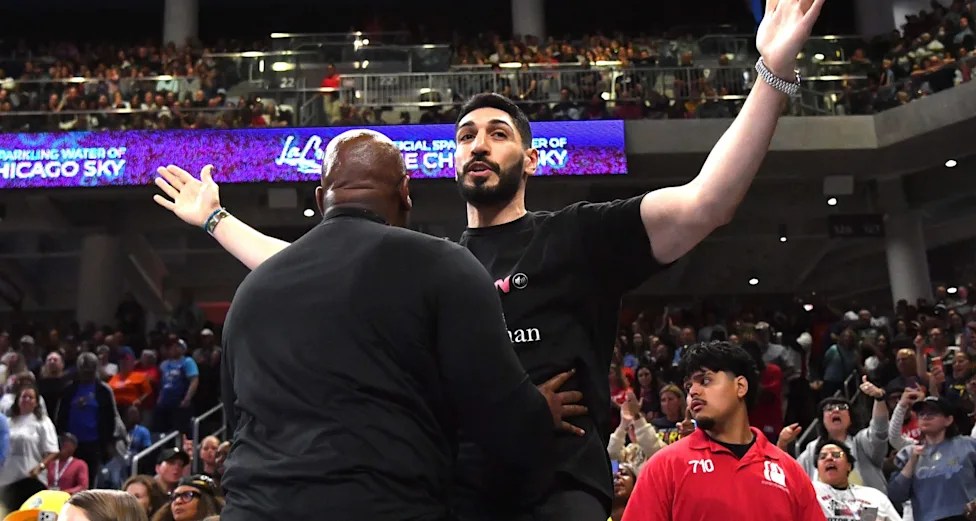
The latest visitor was Enes Kanter Freedom, a former NBA center who has lately reinvented himself as a culture-warpreneur. Freedom arrived courtside for Sunday’s Chicago Sky–Indiana Fever game wearing a T-shirt offering a pointed definition of “woman.” According to the Sky’s subsequent investigation, he began chirping at Natasha Cloud during the third quarter, apparently trying to draw her into an exchange. Cloud approached him during a timeout. Freedom stood, spread his arms and took a step onto the court before security intervened and removed him. The Sky later banned him from their home games, with owner Michael Alter saying Freedom had come to be provocative and “see how much attention he could get.”
That is an impressive amount of nonsense to fit inside one timeout.
The alleged competitive emergency underneath it all has one conspicuous defect: There has never been a transgender woman on a WNBA roster. The league has said there is no immediate eligibility matter before it and has denounced the effort by Freedom and former NBA player Royce White to declare themselves eligible for the draft as a bad-faith attempt to demean or marginalize others. Sources around the league have said neither man is eligible.
An imaginary personnel problem has nevertheless become a real workplace incident.
The Sky eventually did the obvious thing and banned Freedom. Good. But a ban announced two days after the event is the receipt, not the strategy. The broader question remains: Why is one of the fastest-appreciating sports properties in America allowing people with little evident interest in its actual product to commandeer its audience, its cameras and, eventually, its employees?
What does the WNBA think it is getting out of this?
The obvious answer is growth.
In 2024, the league attracted more than 54 million unique television viewers. Attendance rose 48 percent. League Pass subscriptions rose 366 percent. Merchandise sales through the league’s primary retail operation rose 601 percent. Attendance set another record in 2025, and by 2026 the average WNBA franchise was valued by Forbes at $414 million, up 52 percent in a year. The league’s principal national media agreements beginning this season were initially valued at about $200 million annually, four times the value of the preceding contracts.
The WNBA is no longer being discovered. It is being appraised.
That the league needed to grow is not in dispute. Its old customer base, however loyal, was not large enough to support the salaries, media rights, expansion and franchise values the WNBA now hopes to sustain. But the need for more customers does not require management to treat everyone attracted by the resulting attention as a customer worth keeping. Firms routinely decline marginal business when the costs exceed the revenue. A bar wants a crowd. It still employs a bouncer.
Caitlin Clark also does not prove what this argument often asks her to prove. She is evidence that a singular basketball star can acquire customers at extraordinary scale. She is not evidence that controversy is a growth engine, nor that good basketball cannot convert those new viewers into durable, league-wide demand. Customer acquisition and customer conversion are different jobs. Clark can get someone to turn on an Indiana game. A’ja Wilson, Napheesa Collier, Olivia Miles, the rivalries, the playoff races and the game itself have to persuade that person to return when Indiana is not playing.
Nor does Clark’s impact establish that bad-faith actors are an unavoidable toll collected at the gate of mainstream success. Freedom did not create the WNBA’s newly valuable audience. He arrived after it existed. The more plausible sequence may run in reverse: basketball created demand; demand created a larger and more valuable audience; and that valuable audience attracted outsiders who discovered they could exploit it. Calling Freedom a source of growth because he generated commotion around a league that was already growing is like crediting the pickpocket for increasing foot traffic at the fair.
Before accepting provocation as the unfortunate price of growth, the league ought to establish that the provocation is producing growth at all.
The most charitable economic explanation for the league’s caution is option value. Management has acquired an enormous new audience in a remarkably short time and does not yet know precisely what it has acquired. Some are committed basketball fans. Some are Caitlin Clark fans. Some are casual sports viewers. Some are ideological fellow travelers of one kind or another. Some are tourists. Some have arrived principally because there appears to be an argument in progress.
When a company cannot identify which new customers will become permanent, it is reluctant to close any door. A strong institutional response might alienate some unknown portion of the market. Ambiguity preserves the possibility of selling to everyone.
This is rational up to the point at which it isn’t.
An option is valuable only when exercising it might produce a positive return. The WNBA appears to be preserving options not merely for potential customers, but for anyone who sees its newly valuable audience as a stage. Silence may keep the league from offending a future season-ticket holder. It also tells the next provocateur that the premises remain available for rent… and the rent is remarkably low.
Sponsors pay substantial sums for access to the WNBA’s audience. Broadcasters pay for it. Advertisers pay for it. Freedom bought a baseline seat, provoked an exchange with one of the players, and left with days of national coverage. The league supplied the arena, the lighting, the television cameras, the recognizable athlete, and the audience. Freedom supplied a shirt.
Who, exactly, monetized whom?
The central economic mistake is confusing attention with demand.
A person who watches the Freedom–Cloud confrontation 20 times has not watched 20 WNBA games. He has watched one argument 20 times. The distinction tends to disappear on social media, where a view is a view, an impression is an impression and outrage is one of the few commodities that never seems to encounter a supply constraint. A business cannot afford to be so indiscriminate.
Attention means somebody looked. Demand means somebody repeatedly chooses the product and is willing to give up money or time to consume it. Durable demand means the person comes back after the argument has moved somewhere else.
The WNBA’s product is not generic public attention. It is professional basketball. Attention has economic value only insofar as the league can convert it into game audiences, ticket purchases, merchandise sales, sponsorship value, and long-term attachment to teams and players. A viral confrontation may contribute to gross reach while subtracting from virtually every one of those things.
It also carries an opportunity cost. Attention is finite. Every discussion of a hypothetical transgender player who does not exist displaces some amount of discussion about the basketball players who do. Every segment devoted to a courtside agitator is a segment that does not build A’ja Wilson, Napheesa Collier, Angel Reese, Caitlin Clark, or the WNBA playoffs.
The league is not merely receiving additional attention. Some of its basketball attention is being converted into political attention by outsiders who get to keep the proceeds.
This does not make every politically conservative new fan suspect. A conservative who loves basketball, purchases tickets, and disagrees with half the locker room is a customer. No business with national ambitions can require ideological harmony among millions of consumers, and no sports league has ever survived by asking the bleachers to agree on much beyond the location of the exits. Nor does holding a progressive opinion make somebody economically valuable. A person can applaud every stated value of the WNBA and never buy so much as a keychain.
The useful distinction is not progressive against conservative. It is consumer against extractor: One group consumes the product. The other consumes the conflict surrounding the product.
The second group may still buy an occasional ticket, but ticket revenue alone does not establish that a customer is profitable. Management also has to count security expenses, reputational damage, the longtime customer who does not renew, the sponsor who requests an uncomfortable meeting, and the employee expected to absorb the confrontation.
Growth is a gross statistic. Businesses live on net.
That is where the WNBA’s established fan base matters. Not because longtime customers possess a moral deed to the league, but because they have demonstrated economic value. They have watched repeatedly, bought tickets, formed communities, followed players and sustained franchises when the principal WNBA business story was whether anybody would ever do those things in sufficient numbers.
A season-ticket holder is an annuity with a seat assignment.
Businesses routinely undervalue such customers because retention is quiet. Nobody issues a triumphant press release announcing that the same person bought the product again. Customer acquisition photographs better. It comes with charts pointing upward and executives using the word “momentum.” But an uncertain new customer cannot simply be recorded as upside while a dependable existing customer is treated as a sunk cost. Existing customers are not sunk. They are recurring revenue.
The culture surrounding the WNBA is part of the product those customers have been consuming. It need not remain frozen in 2018. Every successful league changes as it grows. But if management alters the experience enough to repel high-retention customers while pursuing people with unproven lifetime value, the relevant number is not how many newcomers arrived.
It is how many valuable customers remain after the transaction.
The WNBA also operates as a multi-sided market. It has players, fans, sponsors, teams, and media partners, each of whom makes the product more valuable to the others. More fans generally make the league more valuable to broadcasters. Larger broadcasts make sponsorship more valuable. Greater revenue permits better compensation, which strengthens the player pool and improves the game.
Those are positive network effects.
But network effects can run backward. A participant who makes the experience worse for players, incumbent customers or commercial partners can subtract more value than a ticket purchase adds. One additional person inside a network is not automatically one additional unit of value. Sometimes the next person simply blocks everyone else’s view.
And then there is labor.
The players are not an in-arena comment section. They are the labor force, the content, and the reason the building has lights.
The growth-related deterioration in their working environment is no longer theoretical. In 2024, WNBA veterans complained that the influx of attention had been accompanied by racist and sexist abuse unlike anything some had previously experienced. The league created a player-safety program in 2025. In July 2026, WNBA and union leaders met again in response to an increase in racist, hateful, and abusive messages, with the league committing to enhanced security resources.
In other words, the externality has already left social media and entered the operating budget.
The league’s growth has unquestionably benefited players. The new collective bargaining agreement increased the team salary cap from approximately $1.5 million in 2025 to $7 million this season, with average salaries projected to exceed $583,000 and future compensation tied more closely to revenue.
That is real progress. It also does not make adverse working conditions free.
Economists call the additional compensation required for a more dangerous, degrading or unpleasant job a compensating differential. Unions generally call it the next bargaining demand.
Players carry two contracts. One is the collective bargaining agreement. The other is the belief that their employer will not rent access to them as part of the entertainment. The first contract can specify salaries, benefits and travel. The second governs trust.
The Sky learned that Freedom was coming roughly three and a half hours before tipoff. His tickets had not been purchased under his name, but his representative alerted the general manager. Alter later said his principal regret was deciding not to inform the players. Security acted when Freedom stepped toward the court, but Cloud had to discover the situation in real time. That sequence sends a message whether management intends one or not:
We knew a person who had publicly inserted himself into a hostile political campaign surrounding your workplace was coming. We did not tell you. We waited to see what happened.
It is not difficult to imagine how employees might update their view of institutional support after that.
This is not an argument that WNBA players must be protected from disagreement, criticism, or ordinary heckling. That would be impossible, and professional sports without heckling would sound like a library during inventory.
It is an argument that management must distinguish between a customer who has an opinion and a person who purchases proximity to an employee in order to manufacture a confrontation.
The WNBA’s own fan code provides for immediate ejection when a spectator attempts to enter the court. Security followed that rule in Chicago. But protecting the workforce cannot begin only after the customer’s shoe touches the playing surface.
Perhaps the WNBA’s cautious strategy will prove correct. A sweeping ban might create a martyr and feed the very attention economy the league is trying to starve. The present turbulence may be a temporary cost of becoming a mainstream sports property. Millions of newcomers may settle into ordinary fandom once the novelty and political opportunism recede.
The league has not been wholly passive. It has denounced bad-faith provocations, established anti-hate and player-safety initiatives, and the Sky acted decisively after Sunday’s incident. The players’ association has likewise said it will not allow its members to be turned into political pawns. But reactive enforcement is not the same thing as product protection.
The WNBA does not need to adjudicate every national political argument. It does need rules clear enough that bad-faith actors cannot profitably pretend an imaginary eligibility crisis exists. It needs league-wide conduct standards capable of distinguishing unpopular opinions from deliberate attempts to provoke employees. And it needs to evaluate its audience using conversion, retention and lifetime value – not merely mentions, impressions, and unique viewers.
The economic ledger should look something like this: Net value of growth = value of acquired customers − incumbent customer attrition − security and enforcement costs − brand degradation − opportunity costs − costs imposed on labor. No one can calculate every term precisely. That does not permit management to declare that only the first one counts.
The mistake is treating growth as the economic consideration and everything being sacrificed to obtain it as politics. The customers who built the league have economic value. The culture surrounding the product has economic value. The stories displaced by manufactured controversy have economic value. Security has a cost. Trust between labor and management has a cost. Morale has consequences.
Everything belongs on the ledger.
The WNBA does not have to choose between old fans and new ones. It has to distinguish between people who want its product and people who want to use its product to sell something else.
The league spent three decades building an audience valuable enough to hijack.
Its next stage of growth requires acting as though that audience belongs to it.

 Big West Dugout