
Yesterday, I asked what Major League Baseball owed to the people who love it. Today, I ask what it owes to the people who play it.
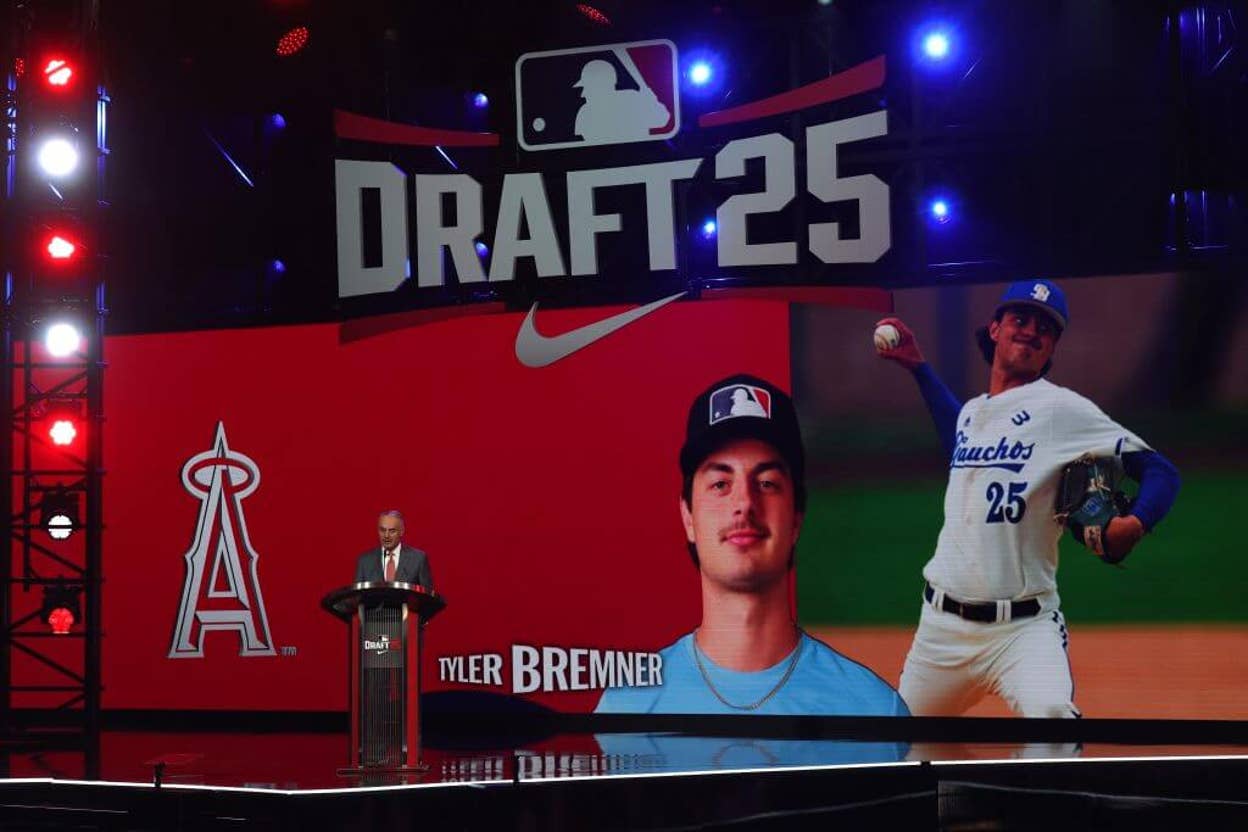
This week, MLB commissioner Rob Manfred floated a sweeping set of changes to the MLB Draft: eliminate high school players from the draft entirely, create an international draft, open college eligibility to players after their sophomore seasons, shorten the draft from 20 rounds to 12, and cut the bonus pool from $358.7 million to roughly $200 million.
There is a version of the pro-college argument that deserves to be considered seriously. If elite high school players are forced into college baseball, the college game probably does get more entertaining in the short term. More future professionals would spend time in college uniforms. Conference races would feature more name recognition. Fans would get better Friday-night arms and deeper rosters.
As a college baseball fan, I understand the temptation. A more loaded college game sounds fun. A more loaded Big West sounds fun.
But a better television product is not the same thing as a better development system. And it is definitely not the same thing as a fair labor structure.
More talent in college baseball does not magically create new value; it changes where existing value is captured. Under MLB’s proposal, players who currently have the opportunity to begin professional careers and receive signing bonuses at 18 would instead spend additional years generating value for colleges, conferences, broadcasters, and Major League Baseball before reaching the same professional marketplace.
The question is not whether fans would enjoy watching more elite prospects in college uniforms. Of course they would. The question is who benefits from delaying those players’ entry into professional baseball. Ask yourself this: Would the commissioner of Major League Baseball make these changes to help college baseball, or to help the thirty ownership groups who sign his paycheck?
If the answer is that colleges get better rosters, broadcasters get better inventory, and MLB gets a cheaper development system, then we should be honest about what is happening.
This is not just a baseball decision. It is an economic decision, and the players are the ones being asked to pay for it.
Maybe the SEC can absorb these changes. Maybe a handful of national powers can. But if MLB wants to argue that college baseball is ready to become a larger part of professional baseball’s development system, the question is not whether a few wealthy programs can handle it. The question is whether the sport as a whole can.
That is where the Big West Conference becomes an important test case.
The Big West is serious college baseball. It wins games, develops prospects, and sends players to the next level. What it does not have is unlimited money. Most of its members are public universities operating under budget constraints that look far more like the rest of college baseball than the financial environment enjoyed by the sport’s wealthiest programs.
The Big West useful here because it represents reality.
If MLB’s proposal does not make sense for the Big West, then it does not make sense for college baseball.
One of the easiest questions to forget in this debate is also one of the most important: Why does the draft exist in the first place?
Once upon a time, players were free to negotiate with any organization willing to sign them. Scouts traveled the country. They attended games, built relationships with coaches and families, evaluated talent, and tried to convince players that their organization was the best place to begin a professional career.
Teams that invested more heavily in amateur talent acquisition generally had an advantage, because investment was rewarded. If an organization wanted access to better players, it had to devote resources to finding them and signing them.
MLB eventually reframed that reality as a competitive-balance problem. Escalating signing bonuses became the justification for the amateur draft, a system designed both to distribute talent more evenly and to reduce the bidding wars that had developed for elite prospects.
But it is worth asking whether that was actually a flaw. Baseball was rewarding organizations willing to invest in scouting and player acquisition. That is not a market failure. That is how competition works.
And the restrictions did not stop with the draft itself.
Long before the draft, MLB attempted to control amateur spending through the Bonus Rule, which discouraged teams from handing out large signing bonuses by requiring certain players to remain on the major-league roster. The rule produced the “bonus baby” era and reflected a growing concern among owners about escalating acquisition costs.
The problem, from ownership’s perspective, was not that talented players were unavailable. The problem was that talented players had leverage. Elite amateurs could choose among multiple organizations. Teams competed for their signatures. Bonuses rose because clubs tried to outbid one another.
When the Bonus Rule failed to meaningfully restrain spending, owners pursued a more comprehensive solution. The amateur draft arrived in 1965 after years of concern about increasing signing bonuses and bidding wars for top prospects. The stated goal was competitive balance, but the practical effect was the elimination of an open market for amateur talent.
Over time, MLB continued tightening the system. Slot recommendations evolved into bonus pools. The 2012 collective bargaining agreement imposed strict limits on draft spending and attached severe penalties to teams that exceeded their assigned pools. Draft spending immediately declined as organizations adjusted to the restrictions.
Seen through that lens, the current proposal is not a radical departure. It is the latest step in a decades-long process.
The pattern is consistent: whenever amateur players gain leverage, MLB looks for ways to reduce it. Whenever teams compete too aggressively for talent, MLB seeks mechanisms to limit the competition. Whenever signing bonuses rise, the system is redesigned to push them back down.
The Bonus Rule limited spending.
The draft limited choice.
Slot recommendations limited negotiations.
Bonus pools limited total spending.
Penalties for exceeding bonus pools limited competition.
Shortened drafts reduced opportunities.
Now MLB is proposing age restrictions, a smaller draft, an international draft, hard slots, and a dramatic reduction in total bonus money.
Every reform is presented as a unique response to a unique problem. Yet they all point in the same direction: less leverage for amateur players. Less competition among teams. Less money flowing to labor.
It is worth pausing on the phrase “competitive balance,” because it has done a great deal of work for Major League Baseball over the years. It justified the Bonus Rule. It justified the draft. It justified slot recommendations and bonus pools and penalties and the contraction of the minor leagues. It will be deployed to justify this proposal as well.
The argument deserves scrutiny, because the actual baseball results do not match the rhetoric. Between 2014 and 2023, nine different franchises won the World Series, including Kansas City, Washington, and Texas — hardly MLB’s financial superpowers. Small-market teams have built contenders. Large-market teams have missed the playoffs. The system, whatever its flaws, has not produced the kind of dynastic lockout that competitive-balance measures are supposedly designed to prevent.
But the more fundamental problem with competitive balance as a justification is that it is unfalsifiable. If parity exists, the restrictions are working and should be maintained. If parity does not exist, the restrictions are insufficient and should be expanded. There is no state of the world in which the answer is fewer restrictions, because the premise is not a diagnosis that can be disproven. It is a permanent argument for permanent constraint.
Baseball rewards competence. It rewards organizations that scout better, develop better, and allocate resources better. Those organizations win. MLB then identifies the mechanisms they used to win and moves to constrain them, calling the constraint “competitive balance.” The pattern is predictable not because MLB is committed to fairness but because MLB is committed to limiting the ways teams can compete for talent. Every new restriction is presented as the final piece needed to level the playing field. The field is never level enough, because leveling the field was never the point. Constraining costs was.
Supporters of the proposal will argue that a hard-slot draft system creates certainty. That is true. It also creates rigidity.
Under the current structure, MLB clubs operate within bonus pools, but they still possess some flexibility in how those dollars are allocated. Teams can save money on one selection and redirect those savings toward another player later in the draft. This maneuvering is not always romantic. Often, it means drafting a college senior who will sign for $10,000 in order to free up pool space for a high school arm with leverage. That is financial engineering as much as scouting conviction. I’m not pretending otherwise. But even that constrained, imperfect version of flexibility represents one of the few remaining places where a team can make a genuine decision about how to value amateur talent.
A hard-slot system eliminates even that limited discretion. Under MLB’s reported proposal, draft bonuses would be fixed within a roughly $200 million system with little or no room for negotiation. Teams would no longer be able to move money around the board. The slot would be the slot. The bonus would be the bonus.
That might sound like a minor procedural change. It is not.
When every pick is assigned a predetermined price, the draft stops being a mechanism for expressing conviction — even the compromised, financially-engineered version of conviction that exists now — and becomes a selection queue. Teams still choose which players to draft, but they no longer decide what those players are worth. MLB decides. MLB sets the price. MLB removes the last remaining point in the amateur acquisition process where a player and a team can disagree with the assigned value and resolve that disagreement through negotiation.
For all the flaws in the current system (and they are real!) it still allows teams to back their evaluations with money. They can identify a player the market has mispriced and use the flexibility of their pool to pursue him more aggressively. They can find a college senior willing to sign below slot and redirect those savings toward a high school prospect with a strong college commitment. The maneuvering is constrained, but the principle survives: teams can still express, however imperfectly, that they value a player differently than the slot system expects them to.
In a mid-major conference like the Big West, the data is thinner, the track record harder to parse, the conviction harder to express. Players are incentivized to use the transfer portal to move to bigger programs – not for their NIL money, but solely for their tracking data.
Hard slots extinguish that principle entirely.
The proposal does not merely reduce how much teams spend. It standardizes how they are allowed to value players. The draft becomes less a marketplace than an allocation mechanism — and the people most affected by that shift are the players, who lose the ability to extract any additional value when a team believes they are worth more than the slot allows.
This is not primarily about scouting romance. It is about who sets the price, and whether anyone is allowed to deviate from it.
For all the discussion about bonuses, draft pools, and competitive balance, there is another consequence that deserves more attention. The proposal changes what baseball organizations are incentivized to value. Today, teams can still bet on projection.
They can look at an 18-year-old high school player and see something that is not yet visible to everyone else. They can trust their scouts, trust their development staff, and believe that what appears unfinished today could become something exceptional tomorrow. That is one of the fundamental ideas behind player development: a prospect is not merely evaluated for what he is. He is evaluated for what he might become.
The current system still rewards organizations willing to embrace that uncertainty. A high school player is not a finished product. He is projection, imagination, risk, and conviction. Teams that identify talent early and develop it successfully can create enormous value. That is the fun of scouting. That is the work of development. MLB’s proposal points in a different direction.
If high school players disappear from the draft and most players enter the professional pipeline only after spending multiple years in college, teams will be selecting older prospects with longer track records, more data, and more standardized résumés. The uncertainty shrinks. The variance shrinks. The opportunities for development-driven organizations to distinguish themselves shrink as well.
Instead of asking, “What can we help this player become?” the incentive becomes, “Which player already looks closest to finished?” That may reduce risk. It may also reduce ambition.
The proposal effectively shifts a significant portion of the developmental process away from professional organizations and onto colleges. By the time many players reach the draft, somebody else will have already done much of the shaping. The scouting challenge becomes less about identifying raw clay and more about selecting among partially completed products.
Organizations that invest heavily in player development have traditionally benefited from finding talent before everyone else recognized it. They could gain an edge through vision, patience, and instruction. But if the system increasingly pushes teams toward older and more predictable players, the payoff for those investments declines.
That is not competitive balance. That is a race to the middle.
This is the part that bothers me most as a baseball person.
MLB’s proposal rassumes that development environments are interchangeable. If a player spends two years in college instead of two years in professional baseball, the thinking goes, he is still developing. The timeline changes, but the outcome remains largely the same. That sounds reasonable until you examine what “college baseball” actually means.
Player development at LSU is not player development at Long Beach State.
Player development at Long Beach State is not player development at UC Riverside.
Player development at UC Riverside is not player development at a junior college.
And none of them are the same as player development inside a professional organization with full-time coaches, medical staff, nutrition programs, analytics departments, strength coaches, and a single mission to make the player better at baseball.
Even within the Big West, programs operate under different realities. Across Division I baseball as a whole, those differences become even larger. Some schools possess resources that rival professional organizations in certain areas. Many do not. And that doesn’t even touch on Division II, III, NAIA, or junior college ball. Player development is not merely the passage of time. Development is the product of environment.
Some players will benefit. Some players will stagnate. Some players will find environments that accelerate growth. Others will find environments that do not.
The point is not that college baseball cannot develop professional players. It clearly can. Every year, programs across the Big West and the rest of the country produce major-league talent. The point is that development quality varies dramatically across the baseball landscape, and if MLB wants colleges to shoulder a larger share of the developmental burden, it cannot simply wave away those differences. A player developed at Cal Poly does not arrive at the draft with the same measurables as a player developed across town at UCLA, but a hard-slot system pays them the same regardless.
The college-baseball fantasy version of this proposal assumes every elite high schooler becomes a campus star, but that is not development analysis; that is fan fiction. Some elite high school prospects would thrive in college baseball. Some would become immediate stars. Some would elevate programs and conferences from the moment they arrived. Others would not.
Some would arrive on campus and discover they are competing against 21- and 22-year-olds who have already spent years in college strength programs. Some would get buried behind veteran players on deep rosters. Some would transfer after struggling to find playing time. Some would get hurt. Some would land in developmental environments that fit their needs perfectly. Others would not. Baseball is full of players who blossomed after receiving the right opportunity and players whose progress stalled because they landed in the wrong situation at the wrong time.
Just as the fact that a player was talented enough to be drafted out of high school does not guarantee he would become a college star, just as importantly, it does not guarantee college baseball would even be the best place for him to become the player he could be.
Even if college baseball receives an influx of talent, it is not clear who actually benefits from that influx. The optimistic version imagines elite high school prospects spreading themselves across the college landscape, raising the level of play everywhere they go. The reality is likely to be far messier. The most coveted players will not suddenly stop preferring the programs with the best facilities, the largest NIL opportunities, the deepest support staffs, the most national exposure, and the strongest track records of producing professional players.
The richest programs will get the first opportunity to absorb the new talent pool. Everyone else will sort through what remains. That creates a predictable chain reaction.
More elite prospects arrive at the top of the sport. Roster competition intensifies. Playing-time opportunities shrink. Logjams develop. Players transfer. Players look for opportunities elsewhere. Talent spills downward.
The SEC gets the first bite. The Big West gets the overflow… that is, until those players enter the transfer portal.
Overflow is not investment.
Overflow creates pressures of its own. More players competing for limited roster spots. More demands on coaching staffs. More scholarship decisions. More developmental responsibility for programs that are not necessarily receiving the resources required to shoulder it. From a Big West perspective, that is the concern.
The conference could become less a beneficiary of the proposal than a pressure valve for it. The talent may flow downhill, but the costs will, too.
It’s easy to talk about draft policy in terms of percentages, bonus pools, and eligibility rules. It’s much harder to talk about what those changes mean for pitchers. Because, for pitchers, this proposal is not just about when money is earned; it is about when risk is assumed.
Under the current system, a high school pitcher selected in the draft has the option to enter a professional organization immediately. That comes with structure. Workload monitoring. Medical staff. Strength and conditioning programs designed around long-term durability. Financial protection through a signing bonus that reflects both talent and uncertainty.
The proposal changes that timeline.
If high school players are removed from the draft, many of the best young arms will be required to spend at least two years in college baseball before they are eligible to be drafted. During that time, they are still throwing. Still accumulating innings. Still managing velocity expectations, competitive workloads, and the constant pressure to perform in order to maintain draft stock. But they are doing it without professional compensation, and without professional-level control over their environment.
Pitching is not a linear development curve. It’s fragile. It’s workload-sensitive. It is shaped as much by usage decisions as by talent. A high school arm who might have signed for significant money and entered a professional system with individualized workload management, pitch design resources, and long-term development planning instead spends those formative years trying to balance performance, durability, and draft positioning inside a college system that serves multiple masters at once: winning games, managing rosters, and developing players under scholarship and academic constraints.
And if something goes wrong, the consequences are not theoretical. An elbow injury. A velocity drop. A missed season. A mechanical adjustment that never takes. For MLB organizations, the financial risk is deferred. For colleges, the player becomes another roster challenge. For the player, the opportunity may never return in the same form.
For pitchers, this proposal does not just delay income; it asks them to carry catastrophic injury risk before they are allowed to be paid. That is the core tension buried inside the cost-shifting argument.
The system does not eliminate risk; it relocates it, and pitchers are where that relocation becomes most visible.
There’s one more downstream consequence to having fewer young players enter professional baseball earlier in their careers. If high school players are removed from the draft and the process is shortened to 12 rounds with a significantly reduced bonus pool, the composition of the minor-league system begins to shift immediately. Fewer 18- and 19-year-olds enter professional baseball. More players arrive older, more developed, and closer to major-league readiness.
MLB has already demonstrated that it sees a relationship between draft volume and minor-league footprint. The 2021 contraction eliminated 42 affiliated teams. That restructuring coincided with the draft being cut from 40 rounds to 20. These were not separate decisions made by separate constituencies. They were part of the same reorganization, justified through the same language of efficiency, facility standards, and player-development optimization. MLB’s position was straightforward: fewer draftees meant fewer affiliates were necessary.
The current proposal would cut another eight rounds. That means roughly 240 fewer players entering professional baseball through the draft each year.
It is true that the relationship between draft rounds and minor-league structure is not perfectly linear. Low-A rosters are also populated by international signees, who made up more than a quarter of Opening Day players at that level in 2023. Rehab assignments flow through the lower levels. Organizations need to field full-season affiliates regardless of how their talent is distributed. These are real considerations.
But they are unlikely to halt the contraction logic, because the international draft MLB is simultaneously proposing would not increase the number of international signees entering the system. The same players who would have signed as free agents would instead be drafted, and if the removal of bidding incentives depresses participation — as it has in the domestic market — the international pipeline could shrink rather than grow. The overall flow of players into professional baseball would still narrow. MLB would still have fewer bodies to assign, fewer development arcs to manage, and a demonstrated willingness to treat fewer players as justification for fewer teams.
It does not require cynicism to see where this leads, only memory. MLB has already made this trade once. The proposal puts the same logic back on the table, this time with eight fewer rounds and a smaller bonus pool providing the justification.
And the cost of further contraction would not fall on MLB. It would fall on the players who lose roster spots, the coaches and staff who lose jobs, the communities that lose affiliated baseball, and the late bloomers who need more time than a narrowed pipeline will ever offer them.
There is another way to describe this, too: MLB’s proposal takes corporate risk and shifts much of it onto publicly-funded institutions. Professional baseball no longer wants to carry as much of the financial risk involved in identifying, signing, and developing young players. So the burden moves elsewhere: to families, to college programs, and very often to public universities already operating under tight budget constraints.
Major League Baseball knows this model well. It has spent decades persuading cities and states to finance stadiums, arguing that the public benefits from the presence of professional baseball even if the revenue flows primarily to the owners. MLB is skilled at positioning public investment as shared opportunity, at describing subsidies as partnerships, at making the case that what is good for baseball is good for everyone. The current proposal applies that same logic to a different part of the pipeline. MLB wants public universities — funded by taxpayers, operating under state budgets, answerable to legislatures — to absorb more of the financial risk involved in developing professional players. The scholarship dollars, coaching salaries, facility costs, and medical resources required to develop an elite prospect would increasingly come from public funds.
If the player succeeds, MLB gains a developed asset. If the player does not — if he gets hurt, stagnates, transfers, or simply fails to progress — the public has already paid for the attempt. MLB captures the upside. The public underwrites the risk. This is not a new story. It is the stadium-financing model adapted for player development, and MLB did not need to invent it. It just needed to call it something else.
If high school players are no longer eligible for the draft, they do not stop developing for two or three years. They still need coaching. They still need training environments. They still need strength programs, medical care, nutrition, travel opportunities, showcase access, and competitive innings against high-level competition. Those costs do not disappear; they move.
In the United States, they move first to families.
Youth baseball has already become an expensive ecosystem, with families spending more than ever to keep athletes in competitive pipelines. Baseball is already one of the most expensive youth sports in America. According to the Aspen Institute’s Project Play initiative, average youth sports spending has risen sharply in recent years, increasing by roughly 46 percent from 2019 to 2024, with families now spending over $1,000 per year on a child’s primary sport on average. But that average understates the true cost of serious baseball development.
Travel ball, showcases, private instruction, specialized training, tournament fees, hotels, flights, rental cars, recruiting camps, and year-round competition can push the cost far beyond the average family’s comfort zone. For many players, getting seen now requires not just talent, but access to an expensive private infrastructure built around exposure. Baseball in America is already disproportionately played by kids whose families can afford the path. Talent still matters, but access matters, too.
By removing the ability for high school players to enter the draft, the system pushes more development time into precisely the environment where costs are already concentrated: the pre-collegiate amateur pipeline. That means more years of private training, more showcase participation, more travel exposure, and more financial commitment required before a player ever reaches a point where professional organizations are allowed to evaluate and compensate him.
You do not need to put a sign on the door saying working-class kids are unwelcome. You just need to make the path expensive enough that their families cannot keep saying yes.
And if that pathway becomes even longer — if players must now wait additional years before they can be drafted — then the financial pressure only increases. More time in the pay-to-play system. More costs borne by families. More dependence on early specialization and private infrastructure.
The proposal also deepens a distortion that already warps amateur development. The pre-draft showcase circuit increasingly rewards players who can produce the right numbers in controlled environments: spin rates, exit velocities, throwing velocities measured on standardized equipment. Those numbers are genuinely predictive, but they are not the same thing as knowing how to pitch, how to hit, how to compete. A 17-year-old who trains to maximize TrackMan output at a Perfect Game event is making a rational decision in a system that will reward him for those numbers. Whether that training makes him a better baseball player — or a healthier one — is a different question, and one the system does not ask with the same urgency. By pushing more players through more years of this incentive structure before they can be drafted, the proposal doesn’t just delay professional entry. It extends exposure to an evaluation environment that increasingly rewards measurable outputs over developed skills.
The result is not a broader talent pool; it is a more filtered one. A system that selects not just for ability, but for access to sustained financial investment during the most formative years of development.
MLB is not entering a neutral environment. It is entering one that already sorts players by economic capacity long before it sorts them by draft status, and then asking that system to carry even more of the load.
Then the costs move again, into college baseball.
That stratification is becoming more pronounced. A quiet assumption sits underneath MLB’s proposal: that college baseball is becoming a more level playing field. More scholarships. More NIL money. More resources. More exposure. On paper, that sounds like a rising tide. In practice, it is more likely to be uneven water levels.
The problem with telling players to “just go to college” is that “college” is not a single economic reality. At one end of the spectrum are programs that can fully fund expanded scholarship limits, invest heavily in facilities, leverage NIL infrastructure, and recruit with the resources of near-professional operations. At the other end are programs trying to adapt to increased financial demands without the donor base, institutional support, or athletic department bandwidth to match.
The proposed shift from 11.7 to 34 baseball scholarships does not erase that divide; it exposes it.
According to Baseball America, the expansion in scholarship limits could require many programs to raise an additional $1 million to $1.2 million annually just to remain competitive under the new structure, and it is widely viewed as a change that disproportionately benefits larger athletic departments with deeper financial backing.
Conferences like the Big West are not programs operating with SEC-level football subsidies or massive donor ecosystems. They are competitive baseball programs housed within public universities, where athletic budgets are balanced across many sports and financial flexibility is limited. So when scholarship limits expand, the gap does not necessarily close. It often widens.
Wealthier programs absorb the change and turn it into an advantage: more roster flexibility, more recruiting power, more depth. Mid-major programs are forced to make tradeoffs: partial scholarships instead of full rides, tighter roster construction, and increased pressure to develop under-recruited players rather than compete directly for the top of the market.
That is not an even adjustment. Benefits accrue most efficiently to the programs already best positioned to capture them.
On top of that, tracking technology like Hawk-Eye and TrackMan is concentrated at wealthier programs, further compounding the resource advantage. The proposal doesn’t just favor programs with more money; it favors programs whose players are more measurable, which is often the same thing.
The Big West does not disappear in this environment. But it competes in a different lane — one defined less by equal access to resources and more by efficiency, development, and finding value where larger programs are already looking first.
Which circles back to the central issue: MLB is asking college baseball to absorb more responsibility for player development, but it is doing so in a system where “college baseball” is becoming more stratified, not less.
The international draft fits this same pattern. MLB will present it as a separate conversation. A different problem. A different market. A different set of solutions. It is not. It is the same logic applied to a different geography.
The stated goals are familiar: transparency, order, and fairness in how international amateur players are signed. The current system, MLB argues, is too informal, too opaque, too prone to early handshake deals and under-the-table commitments. Those concerns are not entirely fabricated. The international market has always operated differently from the domestic draft system, with its own timelines, agreements, and incentives. But the mechanism MLB proposes follows the same pattern seen throughout its domestic draft reforms.
Remove bidding.
Reduce negotiation.
Standardize prices.
Limit player choice.
And present the result as fairness.
Transparency is not the same thing as empowerment. A market can be fully visible and still heavily constrained.
MLB has used similar logic in the domestic draft for decades: slot values, bonus pools, penalties for overspending, and increasingly rigid structures that reduce the range of outcomes available to both players and teams. The international draft would extend that framework globally, applying the same philosophy to a different talent pool.
MLB will call it transparency. But transparency without bidding is not empowerment. It is price control with cleaner paperwork. Different map, same direction.
There is one interpretation of this proposal that is tempting because it feels tidy and familiar: This is just bargaining.
MLB is presenting an aggressive set of changes in order to reset expectations ahead of a new Collective Bargaining Agreement. The real outcome, under this reading, will be something more moderate. A negotiated middle ground. A softened version of the original idea. That may be true in part, but it is not the whole story.
MLB does not need every element of this proposal to survive in order for the strategy to work. It only needs to shift the starting point. If the opening position is extreme enough — eliminate high school draftees, cut the draft nearly in half, reduce the bonus pool dramatically, reshape international signing structures — then even partial concessions can represent meaningful movement toward MLB’s desired outcome. What looks like compromise in the final agreement may simply be a reduced version of a more aggressive baseline.
That is the nature of collective bargaining. The first offer is not meant to be final. It is meant to define the boundaries of what “reasonable” even looks like in later negotiations, which is why it is important not to treat each proposal as a literal prediction of the final system.
It is better understood as a direction of travel.
And that direction is consistent across every component of the plan: fewer amateur entry points, reduced bonus pools, more standardized compensation structures, and tighter control over when and how players can access professional baseball.
This is not a development philosophy; it’s a negotiation posture.
Collective bargaining does not have a pitch clock. The union does not have to swing because the owners threw something near the plate. But the strike zone does get defined by what is put on the table first, and once that happens, everything after it starts from a different place.
If MLB cannot tell the difference between strengthening college baseball and shifting costs onto it, then it understands even less about its talent pipeline than I feared. And if it proceeds anyway, conferences like the Big West will not be a beneficiary of that misunderstanding. They will be where the consequences show up first.

 Big West Dugout