
I have really made an effort over the last few years – no, I swear, I have! – to remove myself from the petty, day-to-day squabbling that politics has become in the social media age. Not because I imagine myself to be in any way above it, but because I don’t imagine that the solution to any of the problems facing us in June 2026 is more noise.
Sometimes, a story comes along and chooses you.
I was not online on June 12th because I was graduating from college. That’s a long story in and of itself – graduating from community college at the age of forty-nine – but the important takeaway is that I did not spend much time online that day. In fact, I wasn’t online much the following weekend, either, as I was on a trip shooting the Milky Way in Anza-Borrego Desert State Park.

So imagine, please, my surprise when I opened my phone and saw the story about Landen Roupp, Ryan Walker, Sam Hentges, and JT Brubaker chose to violate MLB uniform policy on the San Francisco Giants’ Pride Night.
Three of these Giants pitchers added Genesis references to their Pride Night caps, another (Hentges) refused to wear the cap. Their postgame comments framed the controversy as a misunderstanding, but what they largely avoided was the harder question: why LGBTQ fans experienced the gesture as rejection in the first place.
Here’s the thing: I am almost fifty years old. I went to high school ten miles away from JT Brubaker. He pitched at the University of Akron and I played at Kent State, a twenty-minute car ride away when there’s traffic on US-261. As a queer athlete in both high school and college, I have known dozens, if not hundreds, of JT Brubakers. Nothing about this surprised me. What surprised me was how little ownership followed.
I wanted to write something about this not because I want to add more anger or more disappointment to the pervasive culture wars, but rather because I just want you all to know just how exhausted I am.
Let’s talk about Pride Nights. Why do they exist? If you ask most people, they’ll point at the Dodgers’ “Gay and Lesbian Night” in 2000, which was actually a response to an ugly incident where a lesbian couple was ejected from Dodger Stadium for kissing. Sharper-eyed fans might go back a bit farther and point at the Marlins’ “Gay Day” event in 1998.
One thing is for certain: whether called “Pride Night” or something else, Major League Baseball helped set a precedent when it came to showing non-heterosexual fans that they were as welcome at the ballpark as anyone else. And the San Francisco Giants, specifically, set a precedent even within Major League Baseball.
You see, long before any so-called “Pride Night,” “Gay Day,” or “Gay and Lesbian Night,” the San Francisco Giants hosted “Until There’s A Cure Day” way back in 1994 to promote AIDS awareness – a tradition they have carried on ever since. The Giants, historically, are not just a team that happens to play in San Francisco; they have often positioned themselves as a civic institution of San Francisco, which means engaging with a city where LGBTQ identity, politics, public health, and community life are central to the city’s modern history.
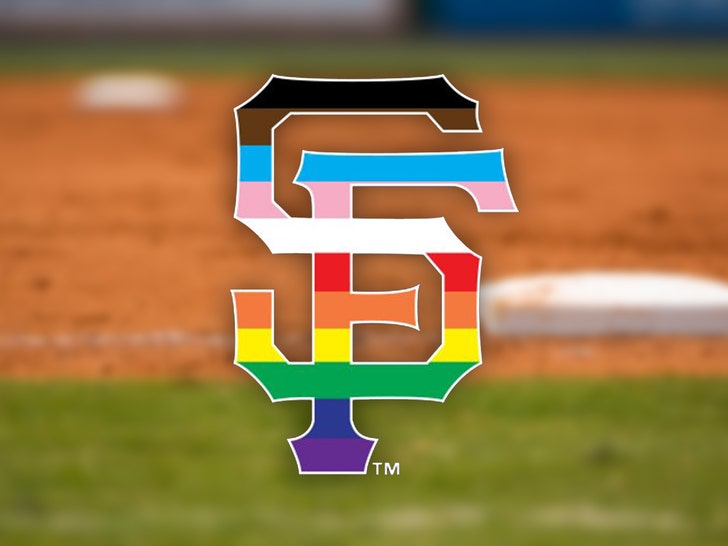
In 2021, the Giants became the first MLB team to incorporate Pride colors into their on-field uniforms, wearing a Pride-colored SF logo patch on the jersey sleeve and a custom cap with Pride colors in the SF logo. That moved Pride symbolism from the concourse into the actual visual identity of the team on the field. In sports terms, that is a bigger statement. It says inclusion is not just an add-on theme night; it is something the club is willing to wear as part of the uniform.
Pride Night isn’t a demand that every player become an activist. It’s an invitation for a community to feel welcome.
So what, exactly, is the controversy is with the Genesis verse players wrote on their caps? I’m not here to debate the theology of the verse itself. I am a practicing Jew; not a fundamentalist Christian, and I have no interest or desire in parsing out the specific meanings these men want to ascribe to this verse.
Symbols acquire meaning through context. If a player writes Genesis 9 on a random Tuesday in August, it means one thing. If he writes it specifically on Pride Night, beside a rainbow logo, it means something else entirely.
If this was simply an expression of faith, why was it expressed only in the exact moment when the rainbow was associated with LGBTQ people?
And this, I think, is where the backlash really begins.
Not with the verse itself. Not exactly. Not even with the refusal to wear the cap, though that is its own statement. The backlash comes from the combination of the act, the setting, and the refusal to acknowledge the setting.
Pride Night is not neutral ground. It is not a random theme night where everyone gets a bobblehead and goes home. It exists because, for a very long time, LGBTQ people were not made to feel welcome in public life, in family spaces, in religious spaces, or in sports spaces. Pride Night is one of the few nights where the institution says, explicitly and without apology: you belong here, too.
So when a player takes the symbol created for that night and alters it with a Bible verse about the rainbow belonging to God, fans are not inventing the subtext out of thin air. They are reading the gesture in the context in which it was made.
That is not unfair. That is how symbols work.
A rainbow on a cap during Pride Night is not merely a rainbow. It is the team’s chosen symbol of welcome to LGBTQ fans. Writing Genesis 9 on that cap does not happen in a vacuum. It happens on the exact night the team has set aside to recognize a community that has spent generations hearing religious language used to justify exclusion, rejection, shame, and political hostility.
That does not mean every Christian is anti-gay. It does not mean every reference to Genesis is hateful. It does not mean every player who wrote the verse sat in the clubhouse plotting cruelty. Again, I cannot know their hearts, and I do not care to pretend that I can.
But I can see what they did, and so can you, and so can they.
They took a symbol being used to welcome LGBTQ fans and placed a competing claim on top of it.
That is why “I meant no hate” is not enough. Maybe they did not mean hate. Maybe they meant witness. Maybe they meant faith. Maybe they meant, as some have suggested, that the rainbow has a biblical meaning separate from Pride. But the act still functioned as a correction. It took the team’s message that LGBTQ fans are welcome here and amended it in real time to serve the players’ own purposes.
It said, in effect: yes, but.
Yes, but the rainbow is God’s.
Yes, but I need you to know I do not affirm this.
Yes, but my discomfort deserves to be visible tonight, too.
And that is the part that lands as rejection. Not because LGBTQ fans are fragile. Not because we are intolerant of Christianity. Not because we cannot handle disagreement. It lands as rejection because Pride Night is not asking players to settle every theological question in American life. It is asking them to participate, for one night, in a basic gesture of welcome.
The players have repeatedly insisted they meant no hate. But they have largely avoided engaging with the more important question: why did LGBTQ fans experience the gesture as rejection?
That is the conversation they seem determined not to have.
Intent matters. Of course it matters. But intent is not the only thing that matters. Impact matters, too.
If I step on your foot and tell you I did not mean to, that may change what you think of my character. It does not change the fact that your foot hurts. And if, after stepping on your foot, I spend three days explaining that I am actually a very loving person, while never once acknowledging that I am still standing on your foot, eventually the conversation is no longer about the original accident. It is about my refusal to move.
That is where the Giants are now.
The organization has tried to thread the needle by affirming Pride Night while also affirming the players’ individual choices. In some abstract HR seminar, maybe that sounds reasonable. In San Francisco, on this subject, with this team’s history, it sounds like evasion.
Because this was not a franchise with no history to draw on. This was the San Francisco Giants.
You do not get to wrap yourself in that history when it is convenient and then act confused when fans expect you to defend it.
That, to me, is the deeper source of the backlash. It is not simply that four players made a choice. It is that the choice exposed a gap between the brand and the culture. The Giants have told LGBTQ fans, for decades now, that they are part of the family. Then, on the night set aside to celebrate that family, several players chose to distance themselves from the gesture of welcome, and the organization responded as if the main problem was everybody noticing.
There is also a reason the “religious freedom” framing feels so hollow here. Nobody asked these players to renounce their faith. Nobody asked them to preach a sermon in support of same-sex marriage. Nobody asked them to become ambassadors for a cause they do not believe in. They were asked to wear the uniform selected by their employer for that game, in the same way players routinely wear camouflage, pink, Jackie Robinson’s number, throwback jerseys, City Connect uniforms, and any number of symbols that are not individually tailored to each player’s conscience.
If a player can wear a gambling sponsor’s patch, a beer logo, a military appreciation cap, or a corporate-branded jersey without stopping the game to clarify his theology, then it is fair to ask why this was the moment that required visible dissent.
Why this symbol?
Why this night?
Why this community?
Those are not gotcha questions. They are the only questions that matter.
And no, the answer cannot simply be “because of my faith,” because faith is not self-explanatory. Faith can move a person toward solidarity, as it did for countless clergy and caregivers during the AIDS crisis. Faith can move a person toward service, humility, sacrifice, and welcome. Faith can also be used as a shield against having to hear the pain of the person standing in front of you.
That is why this hurts. Not because LGBTQ fans do not understand Christianity, but because too many understand this version of it all too well.
We have heard “love the sinner, hate the sin.” We have heard “I don’t hate you, I just can’t affirm your lifestyle.” We have heard “we welcome everyone,” right up until we try to bring a partner, build a family, or exist without translating ourselves into someone else’s comfort zone.
So when a player says he meant no hate, many LGBTQ fans are not hearing something new. They are hearing the language of polite rejection.
And in that sense, the backlash is not an overreaction. It is memory.
It is the memory of being told you are loved while being kept at a distance.
It is the memory of institutions celebrating you in June and abandoning you in July.
It is the memory of being treated as a political controversy when you thought you were just a fan at a baseball game.
That is why the setting matters. Pride Night is supposed to be a respite from that. It is supposed to be one of the rare places where the welcome does not come with an asterisk.
The Giants gave their LGBTQ fans an asterisk.
There is another Giants name I cannot stop thinking about now: Solomon Bates.
Bates was a right-handed pitcher in the Giants’ minor league system, most recently with the Double-A Richmond Flying Squirrels. On August 9, 2022, he came out publicly as gay on Instagram. In the same post, he announced that the Giants had released him.
I want to be very careful here. I am not saying Bates was released because he was gay. I do not know that, nor do I have reason to suspect it. Baseball teams release players all the time for reasons that are brutal, opaque, statistical, developmental, financial, or some combination of all of the above.
But the timing has always stayed with me.
Bates did not simply say, “I’m gay.” He said it while announcing that his time in the Giants organization had ended. He wrote about wanting to open doors for gay athletes like him. He wrote that gay men can play a “manly sport” if given the chance. He thanked the Giants, but also said they had given him a chip to keep going.
That is not an accusation. It is a complicated exit note from a player who clearly understood the weight of what he was saying.
And looking back now, after watching Giants players alter or reject Pride Night caps, Bates’ story feels different. Not because it proves some hidden conspiracy. It does not. But because it reminds us of the question underneath all of this:
What does professional baseball feel like to the queer player inside the room?
Not the fan in the stands. Not the team on social media. Not the organization writing copy for Pride Night. The player. The teammate. The guy sitting at his locker, listening to the jokes, reading the room, measuring how much of himself he can afford to reveal.
Ryan Walker, at minimum, was in that same Richmond pitching group in 2022. Landen Roupp arrived in Richmond later that August, after Bates had already been released, so I do not want to overstate the personal connection. But this was still the same organization, the same developmental pipeline, the same sport, the same culture.
The question is not whether Solomon Bates can be retroactively turned into evidence against any individual player. He should not be used that way. The question is whether the Giants, and baseball more broadly, have created an environment where the next Solomon Bates would feel safe, supported, and fully welcome.
Because openly gay male players in professional baseball remain almost nonexistent. That absence is not accidental. It is cultural. It is the product of locker rooms, churches, families, scouts, agents, fans, front offices, and a lifetime of young athletes learning which parts of themselves are safe to show.
So when players turn Pride Night into a moment of visible dissent, it does not only land on fans. It lands on the closeted player watching from another clubhouse. It lands on the minor leaguer wondering whether coming out would change how his teammates see him. It lands on the kid who loves baseball and already suspects there may not be room for him in it.
That is why “we meant no hate” is such an insufficient answer.
Maybe you didn’t. But would Solomon Bates have felt more welcome after watching that game?
Would the next gay minor leaguer?
This is, of course, not only a Giants story.
If anything, the Giants controversy belongs to a broader pattern across professional sports. The language has changed faster than the underlying attitudes.
There was a time, not very long ago, when the anti-gay rhetoric in men’s sports was blunt. It was slurs in clubhouses. It was casual cruelty from the stands. It was the assumption that an openly gay teammate would be a problem, a distraction, a punchline, or worse. That language has not disappeared, but it has become less socially acceptable in public.
Most modern athletes understand that. They know better than to walk up to a microphone and say they do not want gay people in their clubhouse. They know better than to say LGBTQ fans do not belong at the ballpark. They know better than to openly condemn a Pride Night in those terms.
So the opposition has changed shape.
Now it arrives as an exemption.
A patch not worn.
A jersey skipped.
A cap altered.
A warmup avoided.
A Bible verse added.
A statement that begins, inevitably, with some version of, “I love and respect everyone, but…”
We saw this in 2022, when several Tampa Bay Rays pitchers declined to wear rainbow-colored logos during the team’s Pride Night. Jason Adam, speaking on behalf of the group, framed it as a “faith-based decision,” while also saying it was not judgmental and that the players loved everyone. The phrasing was familiar because it has become the dominant modern language of objection: not rejection, exactly, but non-affirmation; not hostility, exactly, but distance.
More recent examples include Dodgers pitchers Clayton Kershaw and Blake Treinen. (It is telling, by the way, how hard it is to find examples of national media outlets being critical of these players’ actions, especially in contrast to the backlash against the Giants. That is a fight for another day.)
Hockey made the pattern even more visible. In 2023, multiple NHL players declined to wear Pride-themed warmup jerseys, again citing religious belief. The league’s eventual response was telling. Rather than simply absorb the discomfort of inclusion, the NHL eliminated themed warmup jerseys altogether. Pride was not the only theme affected, but Pride was plainly at the center of the controversy.
That is how these controversies tend to resolve: the symbol becomes the problem, not the resistance to the symbol.
And that is why the “I’m not against anyone” language deserves scrutiny. On its face, it sounds tolerant. It sounds humble. It sounds like a plea for pluralism. But to the LGBTQ fan or player on the receiving end, the sentence often lands differently.
“I’m not against you, but I will not wear the symbol that says you are welcome.”
“I love everyone, but I need to publicly distinguish myself from this gesture of inclusion.”
“I respect you, but my conscience requires me to opt out of the one night set aside to tell you that you belong.”
That is not overt condemnation. It is something softer, and in some ways more difficult to confront. It is rejection with clean hands. It is the language of distance wrapped in the language of love.
If your “love” does not include visible acceptance, then frankly what good is it?
This is why simply calling the players homophobic is less interesting than examining the structure of the moment. Whatever any individual player believes privately, the public pattern is clear. Pride initiatives ask sports institutions to make visible room for LGBTQ people. Some athletes respond by making their discomfort equally visible. Then, when fans react, the athletes insist they meant no harm and ask why everyone is so upset.
But the upset is not mysterious.
The upset comes from being welcomed by the team and then corrected by the player.
The upset comes from being told the night is for you and then watching someone use that same night to signal, however politely, that he cannot quite stand with you.
The upset comes from the gap between inclusion as branding and inclusion as culture.
That gap is where these controversies live.
And maybe that is where I land, finally. Not angry, exactly. Just tired.
Tired because the question underneath all of this is not complicated. It is simply:
What does Major League Baseball owe to the people who love it?
Not ideological uniformity. Not forced belief. Not a clubhouse full of players pretending to hold convictions they do not hold. I do not need every baseball player to think like me, worship like me, vote like me, or understand my life perfectly.
But I do think that baseball owes its fans the truth.
Because here is the thing I keep coming back to: I was here long before these guys, and I will be here long after.
Before JT Brubaker was a Giant – or even a Tecumseh High School Arrow – I loved baseball.
Before Landen Roupp threw a major league pitch, I loved baseball.
Before any of these players had a platform from which to explain that they meant no harm, I loved baseball.
And when they are gone – traded, released, retired, forgotten by everyone but the transaction logs and the most committed sickos among us – I will still love baseball.
It is simply the truth of fandom. Players pass through the game. Executives pass through the game. Owners pass through the game, even if never quite soon enough. But fans remain. We carry the history. We teach the rules. We remember the stupid losses, the perfect summer nights, the box scores, the voices on the radio, the players who broke our hearts and the ones who made us believe in something for nine innings at a time.
So what does baseball owe to the people who love it?
At the very least, it owes us enough respect not to treat our belonging as negotiable.
If Pride Night is just a marketing exercise, say that. If inclusion means “you are welcome here, provided no one important feels uncomfortable,” say that. If the rainbow can be placed on a scoreboard, sold on a ticket package, printed on a cap, and celebrated in a press release, but cannot actually be defended when the moment asks for it, then say that, too.
Because what hurts is not simply that some players objected. I am old enough, and have spent enough time in locker rooms, to know those objections exist. What hurts is the insistence afterward that no one should have noticed.
JT Brubaker says he just wants to play baseball.
So do I.
I have wanted to do that my whole life.
That is the point.
Pride Nights exist because, for a very long time, queer fans and queer athletes were told, explicitly and implicitly, that baseball was not for them. Sometimes that message came as a slur. Sometimes it came as silence. Sometimes it came as a joke, a policy, a sermon, a shrug, or a locker room calculation about which parts of yourself were safe to reveal.
Now the language is softer. The rejection is more careful. Everyone loves everyone. Everyone respects everyone. Everyone means no harm.
And still, somehow, on the one night set aside to say that LGBTQ fans belong at the ballpark, the message becomes conditional.
That is the tragedy here. Not that some players still believe what they believe. Not even that some players chose to make that belief visible.
The tragedy is that they seem genuinely surprised when fans notice.
Baseball does not owe me agreement. It does not owe me comfort. It does not owe me a world without disappointment.
But if it is going to keep telling queer fans that we are welcome, then it owes us enough respect not to act confused when we ask whether welcome actually means welcome.
Because I love this game.
That is why this hurts.

 Big West Dugout
One thought on “Welcome… With an Asterisk”